
Google on AI Overviews & AI Search: What Does It Mean for SEO Now?

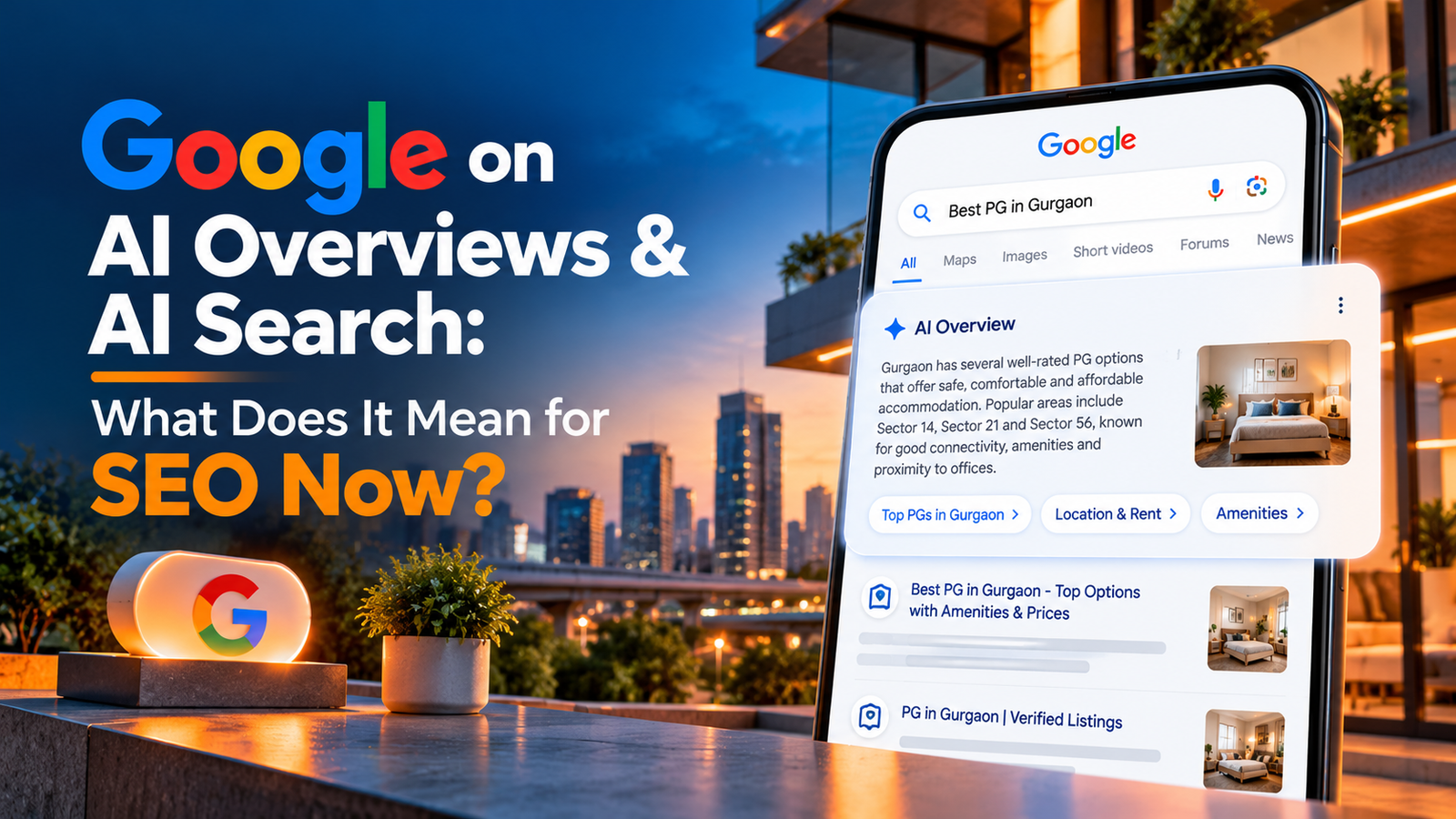
Google Search is changing as AI becomes a bigger part of how people find and explore information. Google reported that AI Overviews were reaching more than 1.5 billion users every month across more than 200 countries in 2025. Google also reported growth in the use of queries that trigger AI Overviews in markets including the United States and India.
For businesses, this raises an obvious question: what happens to SEO when Google itself starts answering more searches with AI?
The answer from Google is relatively straightforward. Google AI Overviews and SEO are not two completely separate systems that require two different optimization strategies. AI-powered search still depends on Google’s underlying search systems, including crawling, indexing, relevance, useful content, and technical accessibility.
At the same time, the search experience is changing. Users can ask longer questions, continue with follow-up queries, and receive answers built from information gathered across multiple searches. This means businesses need to think beyond individual keywords and consider the broader search journey.
What Did Google Actually Say About SEO for AI Overviews?
Google’s guidance does not suggest that businesses need to create a separate SEO strategy specifically for AI Overviews or AI Mode.
The existing fundamentals continue to apply. Google still needs to discover webpages, crawl them, index them, understand their content, and determine whether they are useful for a particular search.
This means SEO for AI Overviews is largely about doing the fundamentals well rather than chasing a completely new set of ranking tricks.
Google has also indicated that there are no special technical requirements specifically for appearing in AI Overviews or AI Mode. Standard SEO practices around crawlability, indexing, content quality, accessibility, and page experience continue to matter.
AI Search Still Depends on Web Content
AI-powered search does not operate independently of the web.
Google’s AI experiences can use information from webpages and provide links that allow users to explore the underlying sources. AI Mode can also use a process known as query fan-out, where related searches are performed across different aspects of a complex question.
This matters because the website still needs to contain useful information that Google can discover and understand.
AI may change how information is retrieved and presented, but it does not remove the need for websites to publish valuable information.
What Google Has Not Said About AI SEO
There is a lot of speculation around how AI Overviews affect SEO, but businesses should separate Google’s documented guidance from industry assumptions.
- Google has not said that websites need to:
- Create a separate AI version of every webpage
- Add special AI-related keywords
- Convert every article into a question-and-answer format
- Publish an llms.txt file to become eligible for AI features
- Stop traditional keyword research
- Replace SEO completely with GEO
- Use a special schema that guarantees inclusion in AI Overviews
The broader point is simple: AI search changes how Google retrieves and presents information, but it does not make established SEO principles irrelevant.
Has Google Changed the Fundamentals of SEO?
Google still needs to find pages, understand them, evaluate their usefulness, and connect them with relevant searches. Technical accessibility, indexability, site architecture, internal linking, content quality, and relevance therefore remain important.
For businesses researching the impact of AI Overviews on SEO, this is probably one of the most useful points to understand.
AI search does not make technical SEO less important. If anything, a website with poor technical foundations can have difficulty being discovered or interpreted by search systems in the first place.
Crawling and Indexing Still Come First
Before thinking about AI visibility, businesses should check whether their important pages are accessible to Google.
Some practical checks include:
- Important pages return successful HTTP responses
- Googlebot is not unnecessarily blocked
- Important CSS, JavaScript, images, and other resources can be accessed
- Canonical tags are implemented correctly
- Important pages have internal links
- Valuable pages are indexable
- Duplicate or low-value pages are not creating unnecessary indexing problems
- JavaScript-rendered content is available to Google’s rendering systems
These are not outdated SEO practices. They remain part of the foundation required for search visibility.
Relevance Still Matters
Google still needs to determine whether a webpage is relevant to what someone is looking for.
What has changed is the level of detail users can include in their searches.
For example, a user might search:
“Best PG in Gurgaon”
Another user could ask:
“What should I check before choosing a PG in Gurgaon if I need good connectivity, suitable amenities and a reasonable monthly budget?”
The second query contains several different considerations. Location, connectivity, facilities and price are all part of the search intent.
This is why content depth matters. Not because Google has announced a specific “topical authority score,” but because comprehensive information gives search systems more useful material to work with.
Website Quality Still Matters
A technically well-optimized website can still struggle if its content is repetitive, shallow, outdated, or created mainly to target keywords.
AI does not automatically make weak content valuable.
For AI SEO, businesses should therefore focus on information that genuinely helps users. Original research, practical experience, expert commentary, case studies, useful examples and clear explanations can make content more valuable than another generic article covering the same points.
The objective should be to create information worth referencing, not simply information that contains the right keywords.
How AI Overviews Are Changing the Search Experience
The bigger change is not necessarily that Google has abandoned traditional ranking.
The change is happening in the way users interact with search.
Traditional search generally follows a straightforward path:
Search query → Search results → Website visit
AI-powered search can introduce additional steps:
Complex query → AI-generated response → Supporting sources → Further exploration → Website visit
This creates a broader search journey.
From One Query to a Search Journey
Users can now ask a question, receive an answer, and continue asking related questions without starting the research process from scratch.
For example, someone researching a product or service may move through questions about:
- Cost
- Features
- Benefits
- Alternatives
- Suitability
- Common problems
- Maintenance
- Providers
- Reviews
A business can potentially become relevant at different stages of this journey.
This changes the way marketers should think about content. Instead of creating one page around one keyword, it can be more useful to build connected resources that address the important questions surrounding a subject.
Query Fan-Out Creates More Retrieval Opportunities
Google has described query fan-out as a process where AI systems can perform multiple related searches across different subtopics and sources.
This is particularly relevant for complex queries.
A single user question may involve several smaller information needs. Google’s systems can retrieve information related to those different needs and use it to construct a broader response.
For businesses, the practical lesson is not to create hundreds of pages for every possible keyword variation.
Instead, build useful pages that answer specific questions and connect naturally through internal linking.
Visibility Is No Longer Just Position 1
Traditional SEO reporting often looks like:
Keyword → Position → Click
AI search introduces another possible path:
Query → AI response → Source selection → Citation/link → Click → Brand interaction
A website may therefore gain visibility through a cited source or supporting result even when the traditional ranking position is not the main focus of the user’s interaction.
This does not mean rankings no longer matter. It means SEO for AI Overviews needs to be viewed alongside the wider search experience.
SEO vs AI SEO: What Has Actually Changed?
The term “AI SEO” is increasingly used to describe optimization for AI-powered search experiences.
But it is important not to treat it as a completely separate discipline.
Traditional SEO still involves:
- Search intent and keyword research
- Technical SEO
- Crawling and indexing
- Information architecture
- Content optimization
- Internal linking
- Authority and backlinks
- Local SEO
- Structured data where appropriate
- User experience
- Performance measurement
These areas continue to provide the foundation.
AI Search Adds More Complex Retrieval
The newer challenge is understanding how information may be retrieved and combined for more detailed queries.
Businesses should make their content easy to understand rather than filling pages with repeated keyword variations.
Clear relationships between topics, useful supporting information, first-hand experience, credible evidence and consistent brand information can all be useful strategic considerations.
However, these should not be presented as confirmed AI Overview ranking factors unless Google explicitly confirms them.
There is no official Google instruction saying that mentioning a fixed number of entities or answering a fixed number of questions will guarantee AI Overview visibility.
Topical Coverage Matters More Than Keyword Volume
Topical coverage means addressing the important parts of a subject instead of producing large numbers of loosely connected articles.
A business might support one core topic with:
- Detailed guides
- Service pages
- FAQs
- Comparisons
- Case studies
- Research
- Supporting resources
These pages can then be connected through relevant internal links.
The purpose is not to “own” every possible keyword. It is to create a useful information structure that helps users and search systems understand the subject.
How Should Businesses Optimize for Google AI Overviews?
Businesses do not need to abandon traditional SEO and start again with a completely different strategy.
A better approach is to strengthen what already works.
Create Original, Useful Content
AI systems can summarize information that already exists across many websites. Generic content therefore becomes easier to reproduce.
Businesses should look for areas where they can add something genuinely useful:
- Original research
- First-hand experience
- Expert analysis
- Case studies
- Proprietary data
- Practical examples
- Detailed recommendations
The more useful the original information, the stronger the reason for another system to reference it.
Answer Real Customer Questions
Do not build the content strategy only around search volume.
Think about the questions customers ask before they contact a business, compare alternatives, make a purchase or use a service.
These questions can reveal informational, commercial, comparison and problem-solving content opportunities.
Demonstrate Genuine Expertise
Experience should be visible in the content.
Where appropriate, include author information, professional experience, evidence, examples, case studies and original observations.
There is a difference between saying that a company is experienced and actually demonstrating that experience through useful information.
Build Connected Topic Coverage
A strong content structure can include guides, service pages, FAQs, comparisons, resources and case studies covering different stages of the customer’s research.
Internal linking helps connect these resources and makes the site’s information architecture easier to understand.
Maintain Strong Technical SEO
Businesses still need:
- Crawlable pages
- Indexable content
- Fast and accessible websites
- Correct canonicalization
- Logical internal linking
- Mobile-friendly pages
- Clear site architecture
Optimize content for AI search only after ensuring that search engines can actually access and understand the content.
Build Legitimate Authority
Relevant backlinks, industry mentions, expert contributions and digital PR can contribute to broader website authority and reputation.
However, businesses should not present these as guaranteed direct ranking factors for AI Overviews.
The focus should remain on earning recognition through useful information and legitimate expertise.
Should Businesses Change Their SEO Strategy in 2026?
Yes, but the change should be an upgrade rather than a complete replacement.
Businesses should consider four practical areas.
1. Improve existing content
Review old pages for outdated information, thin sections, repetition and missing answers. Updating useful pages can be more effective than continuously publishing new ones.
2. Focus on search journeys
Think about the questions users ask before and after a primary search. Build content around the complete research process.
3. Expand useful topic coverage
Create supporting guides, FAQs, comparisons, case studies and resources that genuinely relate to the main subject.
4. Show real expertise
Use experience, research, examples, data and expert input instead of producing another generic AI-written summary.
The goal is not to replace traditional SEO with GEO for SEO. The better approach is to build a stronger SEO strategy that can work across conventional search results and AI-powered search experiences.
How Businesses Can Measure Visibility in AI Search
Measurement also needs to evolve.
Traditional organic metrics should still be tracked:
- Impressions
- Clicks
- CTR
- Search queries
- Landing pages
- Rankings
- Branded and non-branded searches
Google includes AI Overview traffic within overall Web performance data in Search Console. However, Search Console does not currently provide dedicated AI Overview or AI Mode filters that allow businesses to isolate all AI-feature traffic in a separate report.
Businesses can also manually review AI search visibility where possible, including:
- Whether the brand appears
- Which webpages are cited
- Which queries generate visibility
- Whether informational or commercial searches produce mentions
- How often the business is referenced as a source
AI-generated results can vary based on the query, context, location and other factors. A single AI response should therefore not be treated as definitive evidence of ranking performance.
Ultimately, business outcomes remain important:
- Qualified traffic
- Leads
- Inquiries
- Sales
- Bookings
- Assisted conversions
- Branded search growth
What Does Google AI Overviews Mean for SEO Now?
The biggest mistake would be to assume that AI search makes traditional SEO obsolete.
Google’s own guidance points in the opposite direction. The fundamentals still matter: websites need to be accessible, technically sound, relevant, useful and supported by strong information.
What is changing is the way users search and how Google can retrieve information to answer more complex questions.
That means businesses should move from a narrow keyword-first approach toward a broader search strategy that combines technical SEO, useful content, topic coverage, genuine expertise and measurable business outcomes.
The future of Google AI Overviews and SEO is therefore less about finding a secret optimization trick and more about building websites that provide information worth discovering, understanding and referencing.
Frequently Asked Questions:
No. Google has indicated that the existing SEO fundamentals continue to apply to AI Overviews and AI Mode.
AI-generated answers can change how users interact with search results. Some searches may be answered directly, while others can lead users to cited webpages for additional information.
No. GEO can be considered as part of a broader AI-search strategy, but it does not replace technical SEO, content quality, relevance, crawling, indexing or other established SEO practices.
There is no Google guidance stating that a special schema guarantees inclusion in AI Overviews.
No. Google has not recommended creating separate AI versions of webpages simply to appear in AI search features.
Yes. Keyword research remains useful, but businesses should also understand related questions, search intent and the wider journey behind a query.
Focus on crawlability, indexability, useful original content, comprehensive topic coverage, genuine expertise, strong internal linking and legitimate authority. These practices support broader search visibility without relying on unconfirmed AI ranking tactics.
